
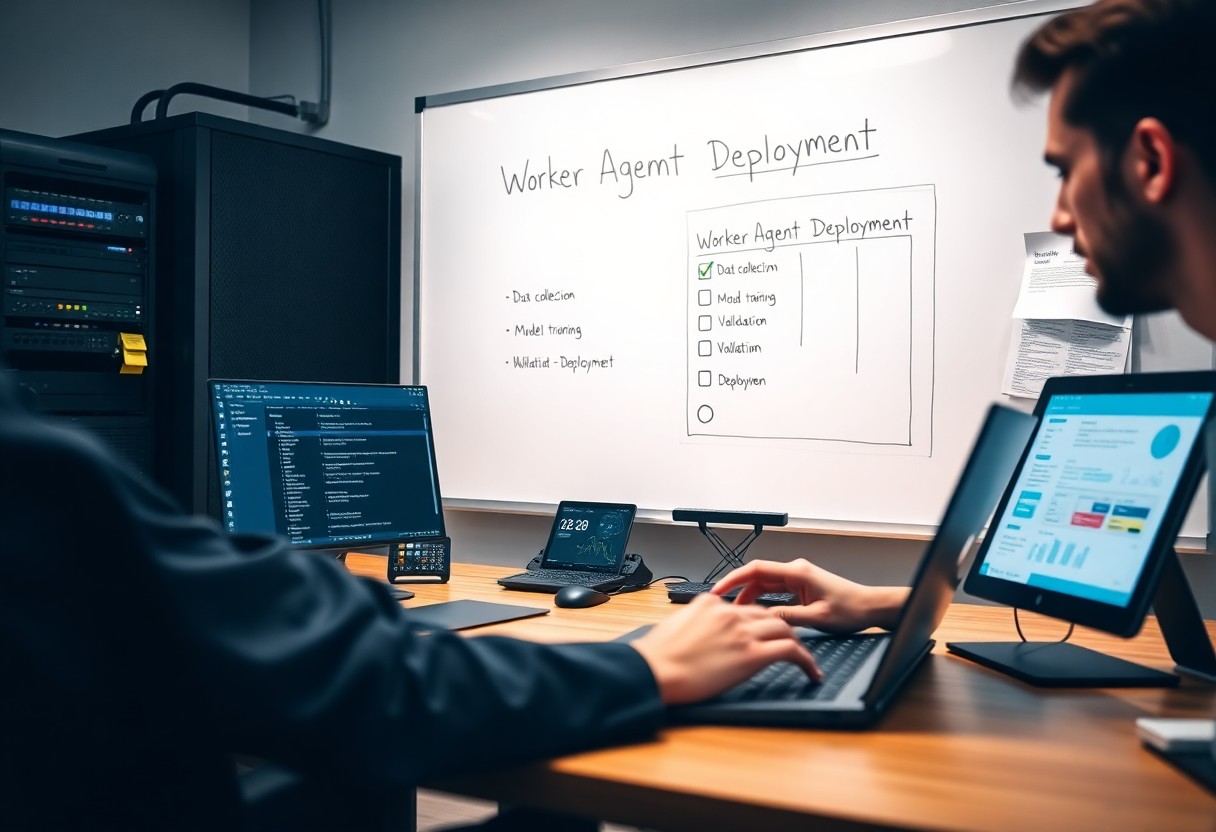
Agent deployment demands disciplined planning: you define precise objectives, design robust task-handling logic, and instrument thorough testing pipelines so your agent delivers predictable results. Prioritize mitigating security and misuse risks and enforce access controls and validation, while you measure impact through real-time monitoring and performance KPIs to iterate fast. Follow deployment templates, rollback plans, and continuous feedback loops so your worker agent scales safely and efficiently.
Key Takeaways:
- Define clear mission, success metrics (KPIs), scope, constraints, and target users.
- Design architecture: select capabilities, tools/APIs, state model, and data access patterns.
- Develop reliable prompts and tool bindings, implement input validation and error handling.
- Run iterative testing with automated suites and human evaluations; log failures and refine models.
- Deploy with monitoring, alerts, safety guardrails, access controls, and a staged rollout for scaling.
Understanding High-Performing Worker Agents
High-performing worker agents combine reliable automation, fast execution, and measurable outcomes so you can scale operations without adding headcount. You measure success with metrics like throughput, task success rate, and mean time to recovery (MTTR); teams often target >95% task success and MTTR under 10 minutes. For example, one fintech deployment cut processing time by 60% while holding accuracy above 99%.
Definition and Importance
A high-performing worker agent is software that executes domain tasks reliably, integrates with your tools, and enforces policies and SLAs. You expect features like observability, authentication, and rollback; typical targets are 99% uptime and 95%+ task accuracy. Teams reduce manual workload, speed cycle times, and gain clearer audit trails when agents operate within defined boundaries and escalation paths.
Key Traits of Successful Agents
Successful agents share traits: robust error handling, explainability, low latency, adaptive learning, and clear goal alignment. You should prioritize error handling, explainability, and low latency (<200ms) for user-facing flows; internal batch agents can trade latency for throughput. Examples include agents with circuit breakers, provenance logs, and scheduled retraining every 24-72 hours.
Error handling relies on retries with exponential backoff, circuit breakers, and fallback chains so you avoid cascading failures; instrumented logs and trace IDs provide explainability. For learning, implement scheduled retraining and real-time drift detection to catch data drift early. You must set monitoring thresholds (e.g., alert if error rate >2% or latency >500ms), enforce safety constraints, and keep human-in-the-loop escalation for ambiguous cases to mitigate dangerous failure modes.
Identifying Core Competencies
When you pin down core competencies, focus on the 3-5 capabilities that directly move metrics-technical delivery, process accuracy, and escalation judgment. Organizations report up to 20% productivity gains when they concentrate on a few high-impact skills. Use small pilots to validate impact: run a 2-week agent pilot, measure task completion and error rates, then lock in the competencies that produce measurable improvements.
Skills and Knowledge Requirements
Define concrete skills like Python, API integration, prompt engineering, data literacy, domain expertise (e.g., healthcare), and soft skills such as decision-making under ambiguity. You should rate each on a 1-3 proficiency scale and assign measurable outcomes-deploy an agent in under 2 hours or pass a 90% test suite-to steer hiring and training.
Assessing Current Workforce Capabilities
Begin with a skills inventory: you map roles to tasks, collect self-assessments, manager ratings, and objective tests, then run 30-minute hands-on microtasks (five per role) targeting core functions. Aim for >=80% success on those tasks, and triangulate with production metrics, commit history, and training records to decide whether to hire, train, or automate.
When you analyze gaps, prioritize those that hit safety, compliance, or revenue-e.g., a 15% defect rate in responses triggers immediate remediation. Create individualized upskilling plans with time-to-competence targets (aim to cut from 6 to 3 months via focused bootcamps), then measure ROI by tracking error rate, time saved, and agent throughput on a quarterly cadence.
Training and Development
Creating Effective Training Programs
You should prioritize the top 20% of workflows that drive 80% of load, start with the 10 highest-volume tasks, generate ~5,000 simulated dialogues plus 1,000 human-annotated edge cases, and combine supervised fine-tuning with RLHF. Track baseline KPIs-task success, latency, error rate-and run 2-4 week sprints to validate improvements against concrete metrics.
Continuous Learning and Improvement
You must implement automated monitoring and feedback loops: log every session, surface failed tasks, and flag model drift. Configure daily dashboards and run A/B tests before deploying updates; aim for a monthly retraining cadence while triaging high-severity regressions within 48 hours.
Operationalize by tracking task success, false-positive rate, latency, and hallucination incidents; set alerts when success drops >3% or hallucinations exceed 1 per 1,000 interactions. Buffer your pipeline with a 20% human-review sample, use tools like Prometheus and Sentry for observability, and automate nightly aggregation so you can retrain on 5-10k curated examples each month.

Implementing Performance Metrics
Setting Clear Goals and KPIs
Define SMART KPIs tied to business outcomes: latency, throughput, task success rate, cost per task, and model drift. For example, you might set latency <200ms, throughput 1,000 tasks/hour, and success rate ≥99%. Assign owners, SLAs for remediation, and link each KPI to a specific test or dataset so you can validate performance during every release.
Monitoring and Evaluating Performance
Deploy real-time dashboards and alerting with tooling like Prometheus/Grafana and Elasticsearch/Kibana, instrumenting traces and logs for every request. Create thresholds such as error rate >1% or sustained latency spikes, and bind alerts to runbooks: triage in 15 minutes, mitigation within 30. Use synthetic tests and user-weighted sampling to catch regressions before they hit production.
Operationalize SLOs and error budgets: set an SLO like 99.9% availability and track weekly budget consumption; when the error budget exceeds 50%, halt noncrucial releases and trigger canary rollbacks. Automate rollback and scaling actions, retain metrics for 90 days for trend analysis, and run monthly postmortems-one payments team reduced incidents by 40% after enforcing these controls.
Leveraging Technology for Optimization
Tools and Software Solutions
Adopt containerization (Docker) and orchestration (Kubernetes) to standardize deployments; combine Terraform for infra-as-code so you reproduce environments reliably. Use CI/CD (GitHub Actions, GitLab) to deploy multiple times per day-DORA shows elite teams achieve that cadence. Add Redis or RabbitMQ for queues, Postgres for durable state, and Prometheus + Grafana for observability. Protect secrets with Vault and centralize logs with Sentry/Datadog to reduce troubleshooting time.
Integrating AI and Automation
Embed LLMs via LangChain or LlamaIndex and implement RAG with vector DBs (Pinecone, Milvus) to return relevant context in milliseconds. Fine-tune or instruction-tune models to lower task error rates, validate against labeled test sets, and run A/B experiments. Orchestrate inference and data pipelines with Airflow or Prefect, and enforce guardrails, rate limits, and model monitoring to catch regressions early.
Instrument inputs, outputs, and confidence scores so you can detect model drift and data skew; log counterexamples for manual review and automated retraining triggers. Roll out changes with canary deployments and shadow traffic to measure impact without full exposure. Track token consumption and latency per endpoint to control costs, and maintain a feedback loop from users for continuous improvement.
Fostering a Positive Work Environment
You should measure and act on engagement data (eNPS, pulse surveys) and run biweekly 1:1s to catch issues early; implementing transparent career paths and a recognition loop can lift retention. Prioritize psychological safety so people speak up, because toxic behaviors drive replacement costs of 50-200% of salary. Use specific rituals-monthly retro, quarterly OKRs, and a mentorship program-to keep morale high and performance consistent.
Building a Supportive Culture
You must train managers in coaching, bias reduction, and feedback delivery, and schedule regular career conversations at least quarterly. Allocate 5-10% of work time for learning and shadowing, create clear promotion criteria, and run anonymous reporting with swift remediation. When managers improve, engagement and productivity rise-manager effectiveness accounts for most variance in team performance-so invest in manager development as a primary retention lever.
Encouraging Collaboration and Teamwork
You should establish daily stand-ups, cross-functional pairing, and shared KPIs to align work; tools like GitHub, Notion, Slack, and Miro support asynchronous coordination. Google’s Project Aristotle found psychological safety is the top predictor of team effectiveness, so enforce norms that normalize dissent and fast feedback. Expect improvements in delivery predictability when teams adopt these rituals consistently.
For more impact, create concrete collaboration rules: require PR reviews within 24-48 hours, run a weekly cross-team demo, rotate pairings weekly, and measure cycle time and mean time to merge. Pilot one change for 6-8 weeks, track metrics, then scale what reduces defects or shortens cycle time; small process experiments often yield >20% gains in throughput when combined with strong norms.
To wrap up
Presently, you can consolidate success by defining clear objectives, selecting the right tools and data, designing concise prompts and feedback loops, testing and measuring performance, and iterating based on metrics and user feedback; by operationalizing these steps and enforcing security and monitoring, you ensure your worker agent delivers reliable, scalable results aligned with your goals.
FAQ
Q: What initial planning steps should I take before building a worker agent?
A: Define the agent’s objective and measurable success metrics (throughput, latency, accuracy, cost); map the end-to-end workflow, data sources, and touchpoints with other systems; identify constraints (compute, budget, compliance) and failure modes; prioritize minimal viable scope for an experiment and draft a rollout plan with stakeholders and rollback criteria.
Q: How should I design the architecture for a reliable, high-performing worker agent?
A: Use modular components (separate orchestration, model runtime, storage, and API layers); make workers stateless where possible and use message queues for decoupling; implement autoscaling, batching, caching, and idempotent processing; design retries with exponential backoff and dead-letter queues; isolate heavy model inference to scalable inference services or GPUs and optimize model size and quantization to meet latency targets.
Q: What data and training practices produce robust agent behavior?
A: Collect representative, labeled data covering edge cases and failure scenarios; clean and normalize inputs, establish annotation guidelines, and perform bias checks; fine-tune models on task-specific data, use validation and holdout sets, and run adversarial and out-of-distribution tests; incorporate synthetic augmentation and human-in-the-loop review for ongoing improvement.
Q: How do I validate and benchmark the agent before production launch?
A: Build unit and integration tests for logic and APIs, simulate realistic workloads, and run load and stress tests to measure throughput and latency under peak conditions; define SLIs/SLOs and acceptance criteria, run canary and A/B experiments to compare performance against baseline, and verify failure handling, observability, and cost behavior under different scenarios.
Q: What operational practices ensure sustained high performance after deployment?
A: Instrument comprehensive observability (metrics, logs, traces) and dashboards for latency, error rates, queue lengths, and costs; set alerting and automated rollback triggers for SLO breaches; implement retraining and data pipelines for continuous improvement, keep a human-in-the-loop escalation path, perform periodic security and compliance audits, and schedule capacity planning and cost optimizations.


0 Comments