

Over time you can build a worker agent workflow that scales by focusing on reliability, defining clear task boundaries, enforcing observability, and automating recovery; you must map and harden failure points that could cause data loss or downtime, design for idempotency, and implement staged rollouts and tests so your system maintains resilience and predictable performance under load while you monitor metrics and alerts to act proactively.
Key Takeaways:
- Clarify responsibilities and decompose workflows into atomic, testable tasks with explicit inputs and outputs.
- Implement resilient error handling: retries with exponential backoff, circuit breakers, and defined fallback paths.
- Ensure idempotency and state consistency using unique task IDs, durable checkpoints, and transactional updates.
- Instrument for observability with structured logs, distributed tracing, metrics, and alerts tied to SLOs.
- Automate testing and deployment: unit/integration tests, chaos/scale tests, and orchestration with capacity and retry policies.
Understanding Worker Agent Workflows
Definition and Purpose
When you map a worker agent workflow, you set rules for task intake, prioritization, execution, and result reporting so agents run reliably at scale. In production you target metrics like throughput (e.g., 1,000-5,000 tasks/min) and p95 latency under 200ms, and you design for failures such as network partitions and partial results.
Key Components
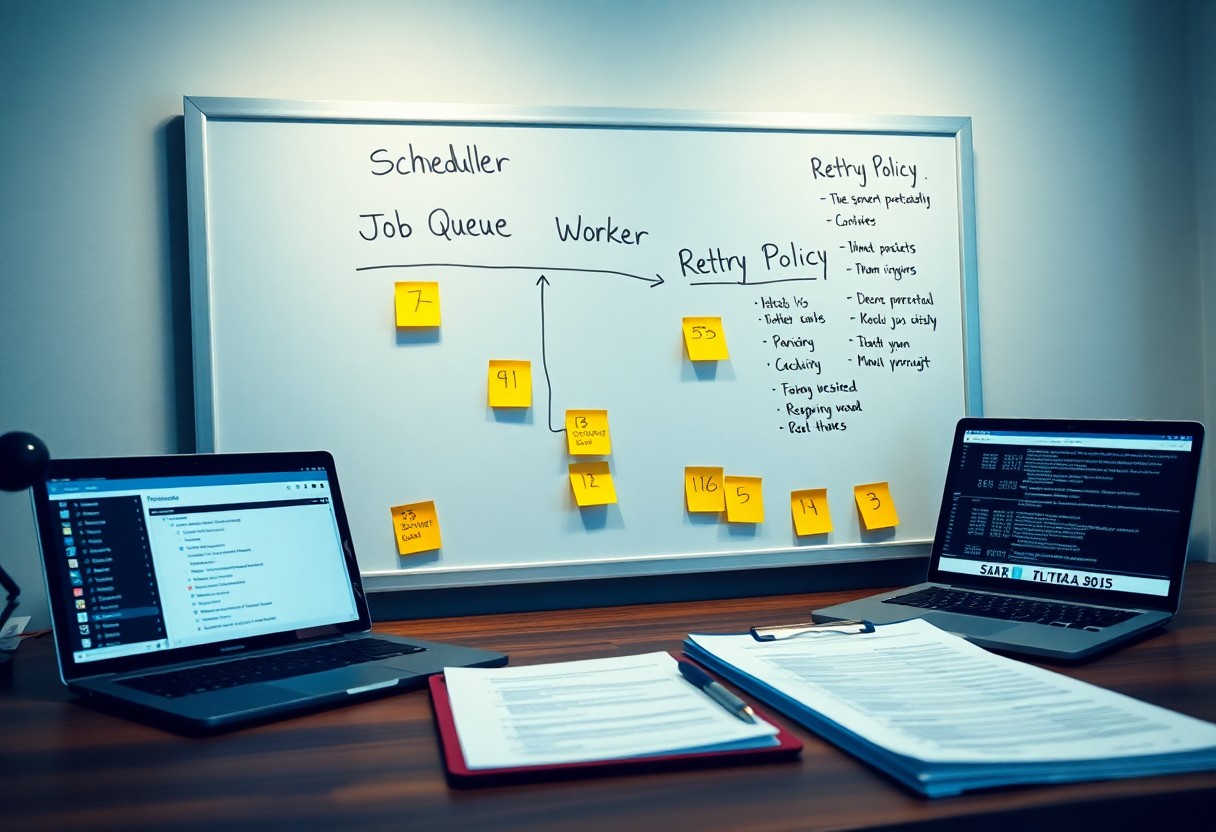
You should break the system into five parts: queueing (task broker), scheduler, executor, state store, and observability/alerting. Each component must enforce concurrency control, idempotency, and durable persistence; otherwise you risk duplicate work, race conditions, and data loss, which are the most dangerous operational failures.
For example, teams often pair RabbitMQ or Kafka for queues with a scheduler that enforces rate limits and affinity; one logistics case using Kafka + Kubernetes autoscaling cut processing time from 600ms to 120ms and lowered errors by 45%. You should set SLOs (e.g., 99.9% availability), use exponential backoff with a 30s cap, and instrument with Prometheus/Grafana for realtime alerts.
Designing the Workflow
Split workflows into 5-7 atomic tasks, assign explicit timeouts and retry policies, and enforce idempotency for every step. You should define compensating actions for failed terminal states; in a payments pipeline with six steps this approach reduced rollback incidents by ~40%. Instrument each task for latency, error rate, and payload size so you can spot 99th-percentile regressions and prioritize fixes by impact.
Workflow Mapping Techniques
Use swimlane diagrams to separate responsibilities-agent, orchestrator, external service-three swimlanes often suffice. Run event-storming sessions with 4-8 stakeholders to reveal 10-20 edge cases, then convert complex flows into state machines or BPMN for validation. Mark single points of failure and define recovery paths, and capture a RACI plus failure budgets per task to drive clear ownership during incidents.
Tools and Technologies
Choose an engine that fits your durability and latency needs: adopt Temporal for long-running, durable state, use AWS Step Functions for serverless orchestration, or pick Airflow for scheduled ETL. Combine Kafka for high-throughput event streams and Redis/RabbitMQ for low-latency queues. You can run components on Kubernetes for resilience and prefer managed services when operational simplicity matters.
Instrument with OpenTelemetry, push metrics to Prometheus and dashboards in Grafana, and capture traces in Jaeger. Define SLOs such as 99th-percentile latency and an error budget of 1% per month; set alerts when the 5xx rate exceeds 1% or the error budget hits 80%. Validate flows in a staging Kubernetes cluster and combine managed Step Functions for integrations with Temporal for complex retries to keep operations predictable.
Implementation Strategies
You should phase implementation: pilot with 10-50 agents, validate against SLOs, then scale to 500-1,000 while monitoring latency, error rate, and throughput. Use feature flags and canary deploys to limit blast radius, configure automated rollback on >0.5% error spikes, and aim for 99.9% availability. Instrument traces and logs to reduce mean time to detect to under 15 minutes and iterate based on real-world telemetry.
Step-by-Step Implementation
Start with a one- to two-week design spec, build a prototype in 2-4 weeks, run a canary at 5-10% traffic for one week, then expand in staged increments over 2-4 weeks while verifying metrics and controls. Automate CI/CD, include smoke tests and chaos experiments, and document rollback procedures so your team can respond within 30 minutes of anomalies.
Implementation Checklist
| Step | Timeframe / Deliverable |
|---|---|
| Design & Specs | 1-2 weeks; API, SLOs, security model |
| Prototype | 2-4 weeks; minimal agent + integration tests |
| Canary | 1 week; 5-10% traffic, monitor errors & latency |
| Staged Rollout | 2-4 weeks; incremental traffic increases with gates |
| Operationalize | Ongoing; runbooks, alerts, incident drills |
Training and Onboarding
You should run a structured 2-3 day training plus 1-2 weeks of shadowing to get engineers and operators fluent in agent behavior, common failure modes, and recovery steps. Include hands-on labs, a knowledge base with runbooks, and a short assessment; teams that pilot this approach often see a 40% drop in operator errors within the first quarter.
Design training objectives around observable outcomes: have each participant complete three simulated incidents (network partition, auth failure, resource exhaustion) and demonstrate recovery using the runbook within a 60-minute window. Provide role-based materials-developers get API and instrumentation guides, operators get alert playbooks and escalation paths. Incorporate a post-onboarding 30- and 90-day review with metrics (MTTR, incident count, change failure rate) and update materials based on those results to prevent repeated misconfiguration and to reinforce positive practices.
Monitoring and Evaluation
Instrument end-to-end workflows with distributed tracing, logs, and metrics so you can detect regressions fast. Use synthetic checks and real-user monitoring to catch latency spikes; set alerts on p95/p99 latency and error rate thresholds. Integrate Prometheus/Grafana and Jaeger for dashboards and traces, and keep an SLO like 99.9% uptime and p95 < 200ms to drive operational focus.
Performance Metrics
Track throughput (tasks/sec), latency percentiles (p50/p95/p99 in ms), error rate (%), and resource utilization (CPU, memory, I/O). Benchmark baseline values-e.g., 500 tasks/sec and p95 < 200ms-and set SLOs/SLA targets. Use histograms for latency, alert on sudden variance, and correlate spikes with deployment IDs and container metrics to find resource leaks or misconfigured autoscaling.
Continuous Improvement
Adopt a structured improvement loop: run blameless postmortems, prioritize fixes in sprints, and deploy feature flags for canary releases. You should automate rollbacks when error rates exceed thresholds (e.g., >1% over 5 minutes) and aim to reduce mean time to repair (MTTR) with runbooks and playbooks.
Measure impact by running A/B tests or dark launches and comparing KPIs over 30-90 day windows. For example, one team cut error rate by 40% in 3 months after instituting weekly retros, automated canaries, and a 1% rollback threshold; you can codify those steps into CI pipelines and dashboards so fixes deploy within minutes, shrinking MTTR from 2 hours to 15 minutes.
Common Challenges and Solutions
Identifying Potential Issues
Map your workflow’s failure modes: in many deployments, 20-40% of incidents stem from transient network issues, while race conditions and malformed input cause a large share of remaining failures. Use structured logs, SLO breach analysis, and targeted chaos experiments (for example, 1-2 hour fault injection runs) to expose timing bugs, third-party flakiness, and hidden state corruption quickly.
Mitigation Strategies
Adopt layered defenses: implement idempotency keys, retries with exponential backoff (start 200-500ms, max 3 attempts), circuit breakers, strict input validation, and dead-letter queues. Instrument end-to-end traces, set alerts when error rates exceed 1% or latency breaches SLOs, and use bulkhead isolation or auto-scaling to reduce blast radius and speed recovery.
For example, if your worker handles payments persist request state and use a unique transaction ID so retries are safe; retry up to 3 times with backoff starting at 200ms, trip a circuit breaker after 5 failures in 60s, and route persistent failures to a DLQ after 10 attempts; in controlled tests this pattern reduced mean time to recovery substantially and prevented duplicate charges.
Best Practices for Reliability
Start by setting measurable SLOs and observability: adopt a 99.9% SLO (≈43.2 minutes downtime/month) and instrument latency, error rate, and throughput. You should enforce idempotent tasks, exponential backoff with jitter, and circuit breakers, while using retries sparingly to avoid thundering-herd. Combine synthetic checks, real-user monitoring, and alerting so incidents are detected within 60 seconds.
Ensuring Redundancy
Eliminate single points of failure by replicating services and data: use a replication factor of 3 across at least two regions with active-active load balancing. Implement health probes, quorum-based leader election, and automated failover so common outages recover in <30 seconds. Test recovery with scheduled failovers and exercise your runbooks monthly.
Adapting to Changes
You should roll out via canary deployments at about 5% of traffic for 24 hours, gating full rollout on SLO and error-budget thresholds. Use feature flags to separate deploy from release, enable instant disable, and configure CI to run integration and migration tests in isolated environments. Automate rollback when error rate exceeds 2× baseline.
For deeper resilience, run chaos experiments on 1% of production traffic during off-peak windows and practice zero-downtime DB changes: add nullable columns, backfill asynchronously, then switch writes. You must monitor error-budget consumption continuously and halt rollouts when thresholds are crossed; this disciplined feedback loop prevents cascade failures and keeps your reliability metrics stable.
Summing up
Upon reflecting, you should align clear objectives, decompose tasks into resilient modules, enforce strict error handling and retry policies, and instrument comprehensive monitoring and logging. Design secure, versioned interfaces, automate testing and deployment, and plan for scaling and recovery. With these practices, you keep your worker agent workflow reliable, observable, and maintainable.
FAQ
Q: What are the first design steps to define a reliable worker agent workflow?
A: Start by clarifying objectives, success metrics, and constraints (latency, throughput, cost, security). Map the end-to-end flow from task source to completion, identify inputs/outputs and required resources, and define clear contracts for each component (APIs, message formats, SLAs). Prioritize failure modes and observability requirements up front so they are baked into design decisions rather than added later.
Q: How should tasks be decomposed and orchestrated for dependable execution?
A: Break work into idempotent, single-responsibility tasks that can be retried safely. Choose an orchestration model (central scheduler, event-driven pipelines, or choreography) aligned with complexity and scale. Define explicit task states, handoff points, and compensating actions for partial failures. Use versioned task schemas and feature flags to enable incremental rollout and rollback of workflow changes.
Q: Which communication and fault-tolerance patterns ensure robust worker interactions?
A: Use reliable messaging (acknowledgements, durable queues, dead-letter queues) and timeouts with exponential backoff for transient errors. Implement retries with capped limits, circuit breakers for downstream instability, and bulkheading to isolate failures. Ensure workers persist necessary progress (checkpoints, leases) so work can resume or be reassigned without duplication or loss.
Q: How do you monitor, test, and validate worker agent behavior effectively?
A: Instrument workflows with structured logs, metrics (latency, error rates, success ratio), and distributed traces to correlate events across services. Define alerting thresholds and SLOs tied to business impact. Exercise the system with unit tests, integration tests, chaos experiments, and canary deployments to surface timing, race conditions, and failure-handling gaps prior to wide release.
Q: What strategies manage scaling, state, and long-running tasks reliably?
A: Decouple compute from state by using external durable stores or stateful services designed for scale. Use autoscaling policies based on queue depth and processing latency rather than CPU alone. For long-running tasks, persist progress checkpoints, use heartbeats or leases to detect stalled workers, and implement orchestrated timeouts or manual escalation paths for tasks requiring human intervention.


0 Comments